08 October 2014

Du musst Caligari werden: The Cabinet of Dr. Caligari and the Beginnings of Horror

The Cabinet of Dr. Caligari. Dir. Robert Wiene. Perf. Werner Krauss, Conrad Veidt, Frederich        Feher. Decla -Bioskop, 1920.


Film is a progressive medium. Each moment of enlightenment, such as the advent of  sound technology with 1927's The Jazz Singer, advances the next generation of movies, steadily expanding the boundaries of filmmaking and making possible revolutions that have lead us to the exciting possibilities of the modern motion picture industry.


Robert Wiene's The Cabinet of Dr. Caligari is one such moment of enlightenment. It has been acknowledged as both the beginning of the German Expressionist movement and one of the first true horror films, and has allowed for the development of the modern horror genre as well as being extremely influential in the advent of film-noir. 


Caligari recounts the tale of Francis, a young protagonist who encounters a sinister man called Dr. Caligari operating a sideshow exhibit at the Holstenwall fair. The exhibit is a somnambulist, Cesare, who has allegedly been asleep since birth, awakening periodically to operate as a soothsayer.  The arrival of Caligari coincides with a series of brutal murders, including that of Francis's friend Alan, an event which was predicted by Cesare. Dr. Caligari and Cesare soon fall under suspicion. After some investigation, Francis learns that Caligari is in fact a madman who induces Cesare to commit the murders by proxy, and the man is admitted into an insane asylum, where he will presumably remain for eternity.


Dr. Caligari (Werner Krauss) 


Of course, as a modern, film-going audience, we are almost trained to suspect a "twist ending." Here, in Caligari, the twist was completely innovative, and was actually imposed by producers who desired a less horrific experience. In the last ten minutes of Caligari, we are informed that the entire narrative was actually Francis's delusion. There is no Caligari. All of the players are actually residents in the mental institution where Francis is also a patient, and the man whom Francis believes to be Caligari is actually Francis's psychiatric doctor. 


Cesare (Conrad Veidt), the sonambulist, and Jane (Lil Dagover)


Considering that the film actually inhabits the headspace of a psychotic, the set design proves itself absolutely appropriate, and is vital to the film's success. As created by designer Hermann Warm, Walter Reimann, and Walter Rohrig, the sets exist at slanted right-angles; everything is distorted, as if the viewer is gazing into a funhouse mirror. Shadows are painted directly onto the sets, emphasizing the horrible two-demionsionality. The psychological result in the viewer is emotional unrest and psychological dread, paralleling and perhaps even compounding the mental state of the protagonist, Francis.


 The atmosphere of Caligari is created not as a direct and faithful representation of reality, but as an assertion of emotion, a window into the interior mind and soul that would otherwise be unreachable. As Caligari employed this technique, it became the first and most prominent example of movement of German Expressionism, and served as an example for later expressionist films such as M, Nosferatu, and The Golem.


Shadows and angles in Nosferatu


It has been suggested by scholars and academics that this development was a reaction to the state of Germany during and immediately preceding the first World War, as film noir was connected to the horrific impact of World War II. Film noir has obvious roots in the German Expressionist movement, as exaggerated lighting was used to create high-contrast, angular shadows that reflected the internal turmoil of angst-ridden detectives as well as the overall vileness of human nature. Directors such as Fritz Lang, Billy Wilder, Alfred Hitchcock, Michael Curtiz, and Carol Reed, using their experience in the German film industry, injected elements of  German Expressionism into their work, creating a genre that is indebted to films like The Cabinet of Dr. Caligari.


Off-kilter set pieces in Carol Reed's The Third Man


Indeed, The Cabinet of Dr. Caligari allowed the use of lighting and set as an expression of psychological and emotional state, which contributed greatly to the cinematic element of "mood." This specific influence is traceable through to today's films- without Caligari, the dark, thickly melancholic atmosphere of David Fincher's films, Se7en, Zodiac, and  Gone Girl in particular, would not be possible.


This film is innovative in its technique and its form, and its influence can be traced through almost a hundred years of film history.As the father of horror and a primary example German Expressionism, the guiding hand of The Cabinet of Dr. Caligari is visible from the modern films of Fincher and Tim Burton to the noirs of the forties and fifties to the monster movies of the thirties and its close German Expressionist cousins.


06 August 2014

Love and Hate: Robert Mitchum in The Night of the Hunter


The late actor Robert Mitchum was born 97 years ago today. It is especially fitting, then, to discuss what was arguably his best performance: the cunning Reverend Harry Powell in Charles Laughton's The Night of the Hunter.


The film itself is notable for many reasons, and especially unique in the canon of film noir. It features impeccable cinematography that borrows heavily from the German Expressionists. It eschews the classic noir urban settings like Los Angeles and New York City for the gothic South. It has influenced today's most prominent directors, David Lynch. Jim Jarmusch, and the Coens among them. Still, its most impressive element just might be its villain and the powerhouse performance delivered by Mitchum.


The Reverend Harry Powell is a serial killer who travels the country preying upon women, marrying and subsequently killing them in the name of God. "These are the things that you do hate, Lord," he says, praying to himself. "Perfume smellin' things, lacy things, things with curly hair." In the pursuit of these "godly" obligations, he hears the rumour of a widow whose husband had robbed a bank and hidden the money. Sure that the widow must know where it is (she doesn't), Powell rushes to court her and her two children.


Of course, Mitchum's portrayal of Powell is impeccable. He allows the audience to see the impossible, psychotic evil that lies beneath the charming exterior. Mitchum showcases Powell's dichotomy perfectly; we perceive his malevolence while at the same time experiencing the believe-ability of Powell as the ultimate con man.

This dichotomy is echoed liberally throughout the film. Powell has the words "LOVE" and "HATE" tattooed across his knuckles, and he explains to the children why: 

              "Ah, little lad, you're staring at my fingers. Would you like me to tell you the little story of right-hand/left-hand? The story of good and evil? H-A-T-E! It was with this left hand that old brother Cain struck the blow that laid his brother low. L-O-V-E! You see these fingers, dear hearts? These fingers has veins that run straight to the soul of man. The right hand, friends, the hand of love. Now watch, and I'll show you the story of life. Those fingers, dear hearts, is always a-warring and a-tugging, one agin t'other. Now watch 'em! Old brother left hand, left hand he's a fighting, and it looks like love's a goner. But wait a minute! Hot dog, love's a winning! Yessirree! It's love that's won, and old left hand hate is down for the count!"


The dicotomy between love and innocence and hate and evil is also emphasized with the juxatopsition between Powell and JJohn and Pearl Harper. There's something especially terrifying about watching Mitchum share the screen with the widow's children. They are innocent and good, and when Powell sweet talks them, touches them, or even looks at them, it seems as though he might be actively corrupting their sweet souls.

Mitchum's ability to radiate the absolute power of evil is tremendous. The result is a villain which the cinematic world will never forget, a villain who will be referenced again and again, a villain who will haunt the minds of every viewer.

02 March 2014

Alain Resnais, master of modern lyricism in film, dead at 91

French filmmaker Alain Resnais died yesterday in Paris at the age of 91.

Resnais's films exist as outliers in the oeuvre of the French New Wave, more closely allied with Left Bank intellectuals like writers Marguerite Duras and Alain Robbes-Grillet. He managed to inject his extremely personal films with the grace and intellectual lyricism usually found only in the masterworks of literature.

The highlights of his career include Night and Fog, a documentary about the devastation of the Holocaust, and Hiroshima mon Amour, a revolutionary fictional meditation on the bombing of Hiroshima, and more generally, the moral depravity of war. Other works include Last Year at Marienbad, The War is Over, and Je t'aime, Je t'aime.


01 March 2014

2014 Oscar Predictions

These are my official predictions for the victors of the 2014 Oscars. Then again, how would I have any idea what's going to win? I'm a female in her early twenties. 

PICTURE
Gravity (Dear God, I hope not)

DIRECTOR
Steve McQueen, 12 Years a Slave

ACTOR
Matthew McConaughey, Dallas Buyer's Club

ACTRESS
Amy Adams, American Hustle

SUPPORTING ACTOR
Jared Leto, Dallas Buyer's Club

SUPPORTING ACTRESS
Luptia N'yongo, 12 Years a Slave

ANIMATED FILM
Frozen

CINEMATOGRAPHY
Emmanuel Lubezki, Gravity

COSTUME DESIGN
Michael Wilkinson, American Hustle

 DOCUMENTARY
The Act of Killing, Joshua Oppenheimer and Signe Byrge Sorenson

 EDITING
Alfonso Cuaron and Mark Sanger, Gravity

BEST FOREIGN LANGUAGE FILM
The Broken Circle Breakdown, Belgium

MAKEUP AND HAIRSTYLING
Adruitha Lee and Robin Matthews, Dallas Buyer's Club

MUSIC
Her, William Butler and Owen Palett

ORIGINAL SONG
"Let it Go" from Frozen

PRODUCTION DESIGN
Judy Becker and Heather Loeffler, American Hustle

VFX
Gravity, Tim Webber, Chris Lawrence, David Shirk, Neal Corbould

ADAPTED SCREENPLAY
12 Years a Slave, John Ridley

ORIGINAL SCREENPLAY
Her, Spike Jonze


If You're a 62-year-old White Male, You'll Love the Oscars


As a person who is both perpetually behind schedule and wont to neglect my duties, I have neglected to write a single review of any of the Oscar nominated films of 2013. This sad reality has led to this: an informal consideration less than a day before the ceremony. To be candid, I lost what little interest I had when my personal favorite film of the year (which I will withhold, for now) failed to receive a nomination in any of the major categories, save Cinematography (definitely deserved, although it will not win. Gravity will surely take the prize this year). This was an affront to my cinematic sensibilities. I'm sure the Coens could really care less. Still, it is a shameful snub, though not entirely surprising. The Oscars have a history of ignoring the right films and praising the wrong ones (see Argo's Best Picture win last year); this can probably be accounted for in its demographics. 77% of the Academy is male, 94% is white, and the median age is a whopping 62. 


As a result of this, most real cinephiles (and most people involved in the film industry) recognize that this particular awards show, and all awards shows, really, doesn't mean all that much in terms of artistic achievement. That sentiment, however, doesn't erase the historic and cultural significance of an Academy Award, as well as the potential for increased publicity and expanded opportunities. 


In conclusion: The Academy Awards are stodgy and frustrating (unless you're a 62 year old white man), but still manage to retain their prestige. 


Let's talk movies. I'm not going to discuss Philomena at all, because I have absolutely no interest in seeing sentimentalized Hollywood drivel, although I really do adore Steve Coogan. Also not on the list is Her, simply because I haven't yet seen it. 


If you need to be reminded of the various nominees, please go here for the official list. 


First things first: I was monumentally disappointed in Martin Scorsese's The Wolf of Wall Street, which took everything that I hated about Goodfellas and amplified it to 11. Scorsese's trademark ebullience was ineffective precisely because of the film's inability to create any kind of complexity. The film took an entire three hours to hit (scream) a single note (DEBAUCHERY! OVERINDULGENCE! DISHONESTY!) over and over again, without variation. As a satire, it seemed entirely unconscious of itself, making it boring to watch despite all of the activity on screen. Leonardo DiCaprio and Jonah Hill are adequate, each making an entertaining spectacle of their characters without injecting any nuance into their performance. All-in-all, I don't think this film earned any of its nominations. 


Although American Hustle is not without its flaws (read: sloppy plot line and slick self-awareness), it does manage to succeed where Wolf of Wall Street fails, offering its audience comedy as well as complexity (!). I think this film is very much held afloat by Amy Adams, who delivers marvelously. With all her charisma, Jennifer Lawrence manages to hook her red talons/nails, although her performance is a little exaggerated. Christian Bale is good but not great, and Bradley Cooper just doesn't cut it. The mania that suited him perfectly in Silver Linings Playbook is too much here. I don't think American Hustle should win for Best Picture or Director due to its overwhelming structural flaws, but Adams should be recognized for Best Actress, and the film definitely deserves a nod for its elaborate costumes. 


Gravity does not live up to its hype; the only thing it has going is its absolutely stunning visuals. The screenplay is very clumsy and heavy-handed, the characters are not fleshed out, and the film is poorly paced. Nonetheless, this may win for Best Picture, as it is such an innocuous, visually spectacular crowd pleaser in the vein of a James Cameron "epic."


12 Years a Slave is an achievement, to say the least. Steve McQueen couldn't have managed a more debilitating examination of the American tragedy that was the institution of slavery. He keeps sentimentality out of the film entirely, brutally forcing his audience to confront one of the worst offenses in human history. The acting in this film is first class all-around (except for a certain producer and movie-star extraordinaire, but that's really beside the point),  and the cinematography is breathtakingly beautiful, a graceful contrast to the ruthlessness of McQueen's images. Ejiofor, N'yongo, and Fassbender all deserve to win in their respective categories, as does McQueen for direction, and the film for best picture. It's difficult to predict if the Academy will embrace the film as a whole, over safer choices like Gravity.


Dallas Buyer's Club is everything a great film should be: well-structured, emotional, and impeccably acted. Matthew McConaughey and Jared Leto both shine in this film, and both underwent incredible physical transformations in order to play their respective roles (which the Academy notoriously adores. The showier the performance, the better). I wouldn't be upset if eithier of these actors were recognized tomorrow night, and I also would not be shocked or enraged if the film was recognized as best picture. 


Honestly, Captain Phillips does not belong here any more than Philomena does. It was a perfectly adequate action film, with an interesting subtext that examines the failure of the American dream, which we have seen in both The Wolf of Wall Street and American Hustle year. Everything about Captain Phillips is good, but nothing is really great. It pains me greatly to think that this is taking up Inside Llewyn Davis's or Short Term 12's spot. 


Finally, Nebraska. I loved this film very much, but as it is, for the most part, quiet and understated compared to its brethren, it will probably be overlooked. The only criticism I have is for June Squibb's character, who seems like a parody of the 'grandma who spots profanities' that we have seen a million times before. Other than that, the movie is honest and true and sweet, and I am pleased that it received mainstream acknowledgement. I would b ecstatic if Bruce Dern saw a win. I really think DeNiro should consider following in his footsteps. 


I also want to briefly mention The Act of Killing. This should, by all accounts, win Best Documentary, as it is one of the most exhausting and challenging films that I have ever seen. I also found three Best Foreign Film nominees to be of note:  The Broken Circle Breakdown (Belgium), The Hunt (Denmark), and The Great Beauty (Italy).


I'll be posting my picks and predictions (in two separate lists, of course) before tomorrow night's ceremony. Please look for my in-depth reviews of the films mentioned above in the coming weeks.


In closing, I would like to suggest that on Monday, after watching at least fours hours of stuffy television, you sit down and enjoy one of the great films the Oscars managed to under appreciate, overlook, or entirely ignore. Inside Llewyn Davis, Short Term 12, Blue Jasmine, Before Midnight, Blackfish, Wadaja, or Blue is the Warmest Color would be a few great places to start.

03 February 2014

"I think you should be serious about what you do because this is it. This is all you've got."

Philip Seymour Hoffman died sometime in the morning of February 2, 2014, at 46. A revered actor, Hoffman graced both the stage and screen, each time able to dedicate himself to finding his character's truth, revealing his flaws in the process, and thus bringing a basic human vulnerability to each performance. A consummate actor, his soul was always visible in his work.

His work is quite personal to me. Hoffman grew up only thirty minutes from where I did, and as such, I always there was a connection between us, some kind of small but significant reason to be proud of his talent and his success, despite the fact that I had nothing at all to do with it. His work in film intrigued and impressed me, especially the films he made with Paul Thomas Anderson and Charlie Kaufman's very special film Synecdoche, New York. I also had the distinct pleasure of watching Hoffman as Willy Loman in the 2012 revival of Death of a Salesman. It was the first time I had seen a play on Broadway, and Hoffman was masterful. He was able to imbue his performance with a beautifully haggard dignity that lived subtly beneath the surface of Loman's quiet desperation.

A few months after watching him on stage, I watched him perform exuberantly in The Master, playing what could have, in the hands of another man, become a calculated, coldly cerebral character. Instead, Hoffman gave us a manipulative master whose insecurities and weaknesses he allows us to glimpse as the fuel behind Lancaster Dodd's megalomania. As he twists his sheep-followers with pseudoscience, supreme confidence, and fatherly condescension, we are allowed to see that there is something poisonous within him, something soft and vulnerable that he refuses to allow to be exploited. In The Master, Hoffman clearly understood the inner workings of not only Lancaster Dodd but of all human beings, an understanding which he was able to bring to very much of his work.

My personal favorite performance of his comes in the 2008 film Synecdoche, New York, which is quite honestly the most complex and the most terrifying movie I have ever seen. Here, he gives us a fucking mess of a person with a fucking mess of a life, who, when tasked with  using the money from a MacArthur Fellowship to write a play that he wants to be truth itself, begins to restructure and manipulate his own life as inspiration. It is a daring meditation on life and death, on what means to die, and on what exactly reality is. This movie came to me at a time when I was unsure about a great deal of things, and Hoffman's Caden Cotard allowed me to come to terms with that uncertainty, to cry and to breathe and to think deeply about my own life, what it meant, and what it could mean. That is really the power of Philip Seymour Hoffman at his best. With his acting, he was able to push you so far off the deep end that you weren't even sure that you had fallen. And then, just when you thought you might be drowning. he allowed you to surface, a mess of adrenaline and thought and more clarity than you would have ever conceded on your own.

It is for this, the power of his performances, that we must remember him. It is not our perogative to judge him, to moralize, to condemn, to turn his life and his work into some kind of perverted cautionary tale. Hoffman was a great artist struggling with something, as all artists do; indeed, as all men do. We must remember him the man who created Lancaster Dodd and Scotty J, who embodied Truman Capote, who reinvented Willy Loman, who brought a heartbreakingly heavy sense of human flaw and vulnerability to every role that he played. Let Hoffman live in the memory of ages as a beautiful artist whose talent will transcend his ephemeral life.

Philip Seymour Hoffman did not speak this monologue from Synecdoche, New York, but his character listens to it. I think this speech stands as an appropriate memorial to Hoffman's exceptional genius. Thank you, Mr. Hoffman.

"Everything is more complicated than you think. You only see a tenth of what is true. There are a million little strings attached to every choice you make; you can destroy your life every time you choose. But maybe you won't know for twenty years. And you may never ever trace it to its source. And you only get one chance to play it out. Just try and figure out your own divorce. And they say there is no fate, but there is: it's what you create. And even though the world goes on for eons and eons, you are only here for a fraction of a fraction of a second. Most of your time is spent being dead or not yet born. But while alive, you wait in vain, wasting years, for a phone call or a letter or a look from someone or something to make it all right. And it never comes or it seems to but it doesn't really. And so you spend your time in vague regret or vaguer hope that something good will come along. Something to make you feel connected, something to make you feel whole, something to make you feel loved. And the truth is I feel so angry, and the truth is I feel so fucking sad, and the truth is I've felt so fucking hurt for so fucking long and for just as long I've been pretending I'm OK, just to get along, just for, I don't know why, maybe because no one wants to hear about my misery, because they have their own. Well, fuck everybody. Amen."


18 October 2013

New Releases: Friday, October 18

A list of the new releases for Friday, October 18, 2013, in order of my personal anticipation.


12 Years a Slave

12 Years a Slave tells the true story of Solomon Northrup, a free man living in the antebellum North, who is abducted and forced into slavery. At the helm is Steve McQueen, celebrated director of Shame and Hunger. The film promises a superb cast, with Chiwetel Ejiofor in the lead role with additonal parts played by Michael Fassbender, Quvenzhane Wallis, Brad Pitt, and Benedict Cumberbatch. Most are predicting this film to be a serious Oscar contender come February.


Kill Your Darlings

This film explores the obsessive friendship between Allen Ginsberg (Daniel Radcliffe) and Lucien Carr, as well as their interactions with other famous Beat Generation writers Jack Kerouac and William Burroughs. When a murder is committed by Carr, the group is forced to reconcile with it, which perhaps draws them closer together. Daniel Radcliffe's role as Ginsberg ranks in one of the most interesting and challenging roles he has taken since the end of the Harry Potter franchise. The film seems to be a meditation on the circumstances and mentality of the New York Beat Generation writers which will hopefully rise beyond a simplistic crime drama.


The Fifth Estate

An account of the relationship between Julian Assange (Benedict Cumberbatch), the founder of WikiLeaks, and Daniel Domscheit-Berg (Daniel Bruhl), his colleague. I haven't seen the film yet, but I am vehemently hoping that The Fifth Estate will take the opportunity to explore the dubious morality of the intentional leaking of classified documents. A.O. Scott's New York Times review suggests that it's been turned into a type of global thriller with a poorly contrived imitation of the The Social Network's portrait of the conflict between Mark Zuckerberg and Eduardo Saverin.


Carrie 

A remake of the classic Brian DePalma film, itself an adaptation of the seminal Stephen King novel (essentially, a remake of a remake). Early reviews indicate that there's nothing special going on in this film, as it continues a long tradition of taking classic horror films and bringing nothing new to the table. Also, no actress can eclipse the equally terrifying and heartbreaking performance Sissy Spacek brought to the film's titular character.


All is Lost

All is Lost features Robert Redford as a sailor who, after a collision at sea, finds himself forced to confront the possibility of death in order to survive. The film screened out of competition at Cannes in 2013, and has gotten fairly positive reviews. It appears to be a simplistic but well-executed story of survival with a fantastic performance given by Redford.


Escape Plan

If you want to see a prion escape film, watch Coolhand Luke on TCM. Starring Sylvester Stallone, Arnold Schwarzenegger, and 50 Cent.


17 October 2013

Watch the Brand New Trailer for Wes Anderson's Latest

The trailer for Wes Anderson's newest effort, The Grand Budapest Hotel, premiered today. The film is due for a March 2014 release. Watch it below:


The Grand Budapest Hotel follows the legendary hotel concierge Gustave H (Ralph Fiennes) and his plucky lobby boy Zero Mustafa (Tony Revolori) as they embark upon an adventure involving the theft of a famous Renaissance painting and the distribution of an immense family fortune played out against the backdrop of 1920s Europe.


The Grand Budapest Hotel promises Anderson's usual colorfully quirky characters, some played by Andersonian regulars and others portrayed by newcomers. Its cast includes Saiorse Ronan, Edward Norton, Willem Defoe, Jude Law, Owen Wilson, Lea Seydoux (who also stars in the controversial Blue is the Warmest Color), Adrien Brody, Tilda Swinton, Jeff Goldblum, Tom Wilkinson, Jason Schwartzman, and most importantly, Bill Murray. Because it wouldn't be a proper Wes Anderson feature without Bill Murray. Especially when he sports a moustache as fabulous as this one.


Here are two other Anderson regulars in their Grand Budapest roles:


And here is Edward Norton, playing what looks to be a very similar character to his noble Khaki scout leader Scout Master Ward.


The Grand Budapest Hotel promises to deliver many of Anderson's stalwart techniques: meticulous set decoration, whimsical pomposity, an obsession with old money, and plenty of nods to the French New Wave.

16 October 2013

Watch Matt Zoller Seitz's video essays on Rushmore & Bottle Rocket

Matt Zoller Seitz, writer and film critic, released The Wes Andserson Collection, a book that details the life and films of the American writer/director Wes Anderson. According the book's website, it is an "in-depth overview of Anderson’s filmography, guiding readers through his life and career. Previously unpublished photos, artwork, and ephemera complement a book-length conversation between Anderson and award-winning critic Matt Zoller Seitz. The interview and images are woven together in a meticulously designed book that captures the spirit of his films: melancholy and playful, wise and childish—and thoroughly original."


Anderson's filmography includes the films Bottle Rocket, Rushmore, The Royal Tenenbaums, The Darjeeling Limited, Fantastic Mr. Fox, Moonrise Kingdom, and the upcoming The Grand Budapest Hotel, as well as several short films and a commercial for Prada.


Matt Zoller Seitz also made a few enlightening video essays on Wes Anderson's films in conjunction with the release of his book. Most of the essay is taken from the text itself, but definitely worth watching, especially if you do not plan to purchase the book (you should!).


Zoller Seitz's essay on Anderson's first feature film, Bottle Rocket:


And his discussion of Rushmore:


Anderson is a fairly important filmmaker to me. Rushmore was of the films I saw in middle school that sparked my investigation of other quirky independent features, and also inspired my interest and eventual passion for cinema of all kinds. I was also able to see the tenth anniversary Lincoln Center screening of The Royal Tenenbaums that occurred in conjunction with the New York Film Festival. After the screening, Anderson, his brother, Anjelica Huston, Bill Murray, and Gwyneth Paltrow spoke about the film, providing some interesting anecdotes about working with Gene Hackman and hinting about his new film (Moonrise Kingdom, released in 2012 and nominated for several Academy Awards). I believe that Anderson is truly one of the most creative filmmakers working today, and hope to see him working prolifically in the industry for a long time to come.


15 October 2013

How Do They Do That?: Split Focus Diopters

In order to understand cinema at a deeper and more meaningful level, one must be willing to investigate the technology that makes the artistry of a film possible. And as film is an extremely technical medium to work with, it is essential to learn, in as much detail as possible, about its many technological components. 


This post will consider the split focus diopter, a device used to achieve a very specific and unique visual effect.


The split diopter, pictured above, attaches to the lens of the camera. Half of the diopter is comprised of convex glass (in this example, the right half), while the other half is left empty. This allows the camera to capture two different planes in the frame, both clearly defined and acceptably focused. The diopter is able to focus on the foreground while the camera lens simultaneously focuses on the background.


Use of the diopter achieves a similar effect to that of the traditional deep focus, in which there is a very large depth of field, in which the foreground, middle ground, and background are all in focus. However, the split diopter causes one extremely unsubtle difference: the middle-ground appears blurry, lacking the continuous depth of focus that traditional deep focus offers.


Traditional deep focus in Citizen Kane


Split diopter in Star Trek: The Motion Picture


Notice the there is an out of focus line of demarcation between the foreground and background in the frame from Star Trek: The Motion Picture.

Use of the split diopter became popular after its invention in the 1970s, and was favored especially by director Brian DePalma. Editor Vashi Nedomansky compiled all 15 of the split diopter shots contained within DePalma's 1981 Blowout in this video

.
In fact, DePalma still uses it today, as is evidenced by the still below, taken from his recent film Passion:


Split diopter in Passion


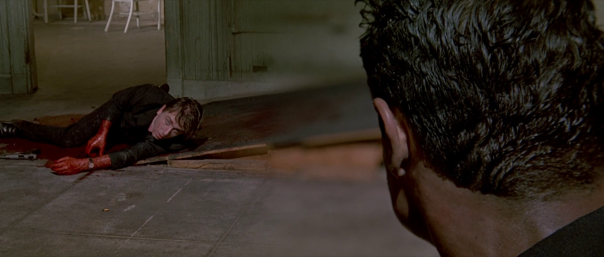
Quentin Tarantino used the visual effect in his 1992 debut  Reservoir Dogs:


Reservoir Dogs